

Waiting for mammography results can feel interminable, yet the typical 2–7 day window reflects multiple radiology workflow stages—not clinical urgency or the complexity of your scan alone.
Understanding which workflow factors extend turnaround time empowers you to choose facilities that prioritize integrated reporting and to follow up proactively when delays exceed institutional norms.
Key Takeaways
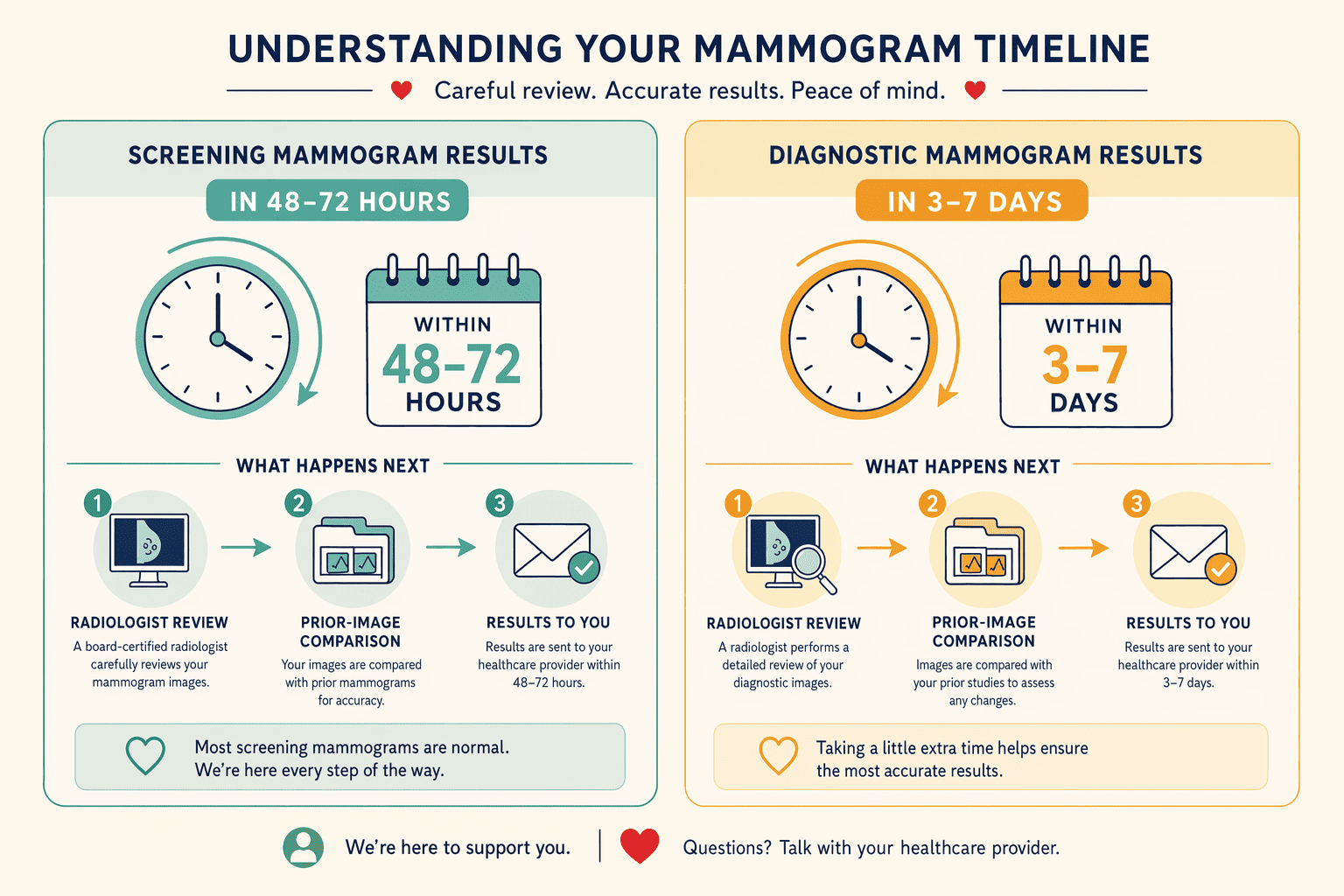
- Screening mammograms typically yield results within 48–72 hours, while diagnostic mammograms require 3–7 days due to comparison with prior films and additional views.
- Six workflow variables drive delays: radiologist availability, image quality retakes, prior-comparison workload, screening versus diagnostic complexity, technology integration gaps, and outsourced teleradiology.
- Delays almost never signal abnormal findings—the FDA requires notification within 30 days, so 2 to 7 days remains well within normal administrative range.
- Integrated radiology departments with on-site radiologists, PACS integration, and same-roof oncology coordination achieve same-day or next-day turnaround without sacrificing accuracy.
- Follow up with the radiology department after 5 business days for screening exams and 7 business days for diagnostic mammograms if you have not received results.
How Long Does It Typically Take to Get Mammography Results?
Most screening mammogram results arrive within 48 to 72 hours, though diagnostic mammograms, which require additional views, comparison with prior films, and radiologist consultation, typically take 3 to 7 days. Many imaging centers, including Andromeda Cancer Hospital, now deliver same-day or next-business-day reporting when appointments are completed early in the day. The actual turnaround depends on six workflow factors: radiologist availability, image quality, prior-comparison workload, screening versus diagnostic complexity, technology infrastructure (PACS integration versus film-based systems), and whether reads are outsourced to teleradiology services.
Screening Mammogram Turnaround: 48-72 Hours
Screening mammograms, routine exams for women without symptoms, are read faster because they follow standardized protocols. Images are transmitted digitally to a radiologist, interpreted, and reported within 24 to 72 hours at most facilities. High-volume centers with dedicated breast radiologists often deliver results within 24 to 48 hours, while some academic institutions report 1 to 3 business days. The FDA requires facilities to send written results within 30 days, but most exceed this standard.
Diagnostic Mammogram Turnaround: 3-7 Days
Diagnostic mammograms focus on specific areas of concern and require longer review. Radiologists compare new images with prior studies, consult with technologists to obtain additional views, and may coordinate with other specialists before finalizing the report. This deliberate process typically extends turnaround to 3 to 7 days, though some centers provide preliminary findings during the appointment. The extra time reflects thoroughness, not urgency.
Delays Do Not Mean Abnormal Findings
Workflow bottlenecks, not clinical urgency, drive most delays. Radiologist availability, time-of-day submission (evening scans queue overnight), weekend appointments, and prior-film retrieval all affect turnaround. The FDA mandates that suspicious findings trigger contact within 3 business days, so a 5- or 7-day wait for routine screening results signals operational pacing, not a red flag. The next section unpacks the six factors that determine your specific timeline.
Those timelines are not arbitrary, they emerge from six modifiable workflow design choices that ripple through every radiology department's reporting chain.
Six Workflow Factors That Affect Mammography Turnaround Time
Mammography delays are not passive inconveniences, they are the product of six modifiable workflow variables that compound across the radiology reporting chain. Understanding these mechanics helps explain why your results may take days or weeks, and what factors separate fast-turnaround facilities from slow ones.
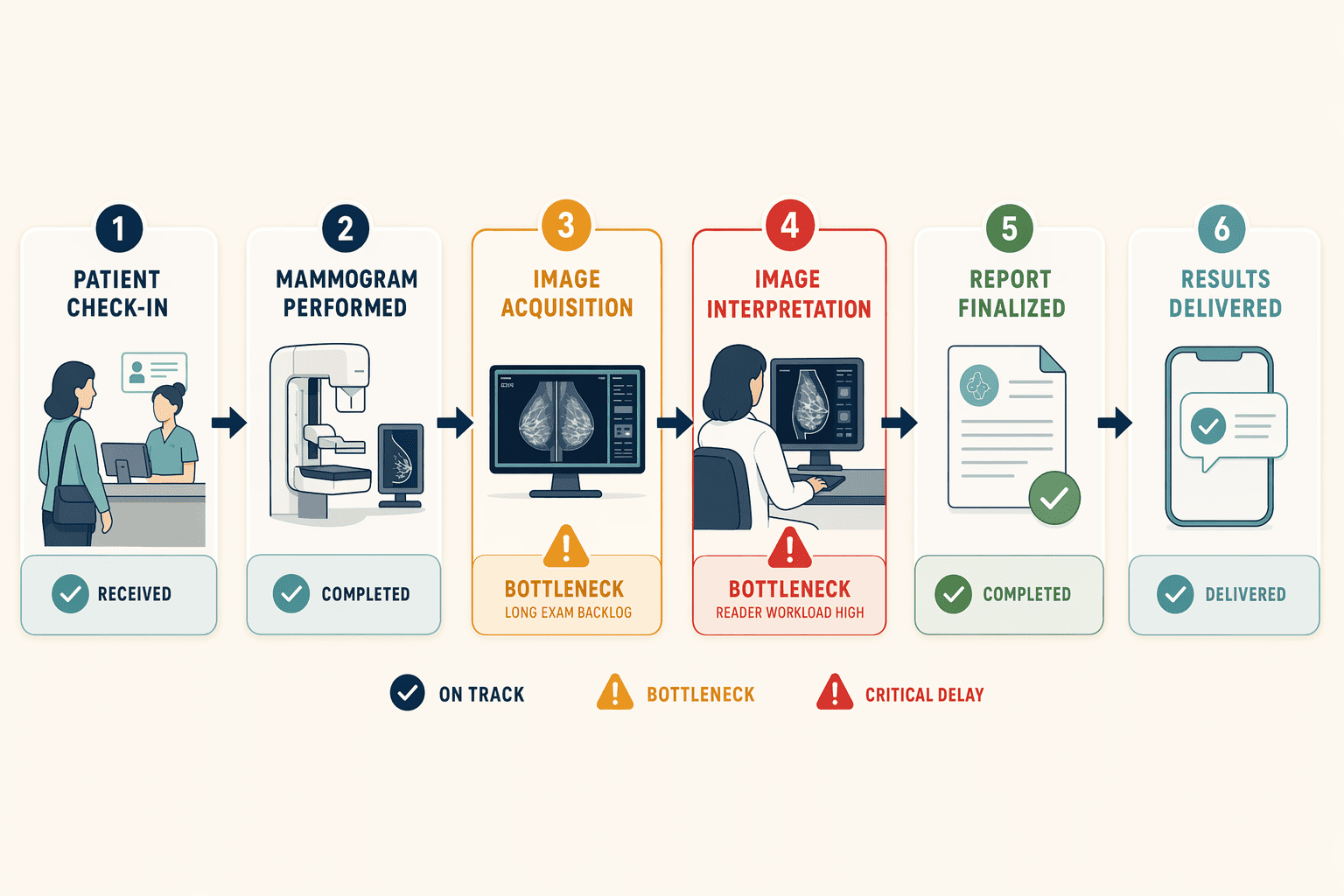
- Radiologist Availability and Staffing. Subspecialized breast radiologists are scarce, and their schedules directly gate turnaround. When a screening mammogram arrives Friday afternoon and the breast radiologist is off-duty until Monday, the comparison-film retrieval and double-read protocol cannot begin until the following week. In South Australia, a radiologist shortage pushed BreastScreen SA's turnaround from its 14-day goal to 28 days, forcing women to wait more than twice as long for results. Six extra radiologists were recruited to close the gap, but training and onboarding delays mean staffing fixes take months, not weeks.
- Image Quality Issues Requiring Retakes. Motion artifacts, poor positioning, or dense breast tissue can trigger a callback for additional views. Screening mammograms use low-dose X-rays to detect abnormalities before symptoms appear, but when image quality is compromised, the patient must return, restarting the entire workflow from acquisition through interpretation. Each retake adds days to the reporting timeline, especially when scheduling slots are already constrained by high screening volumes.
- Prior Mammogram Comparison Workload. Radiologists must compare current images against prior films to detect interval changes. When prior mammograms are stored at external facilities rather than in an on-site PACS, the retrieval process involves manual courier requests, phone confirmations, and physical film scanning or digital transmission delays. At Andromeda Cancer Hospital, PACS is used to store, retrieve, view, and share medical imaging files, enabling instant comparison without external delays, but facilities without integrated PACS face multi-day bottlenecks when prior films must be physically transported or digitally requested from outside archives.
- Screening vs Diagnostic Complexity. Screening mammograms are read for large-volume throughput, but diagnostic mammograms, ordered when a patient develops a new symptom such as a lump or nipple discharge, require radiologist consultation, callback protocols, and sometimes same-day additional views. This complexity adds reporting time because the radiologist must correlate imaging findings with clinical history and decide whether immediate follow-up is warranted, pulling the study out of the batch-processing queue into individualized review.
- Technology Gaps: PACS vs Film-Based Systems. Digital PACS integration allows instant transmission of images to radiologist workstations and cloud-based comparison with prior studies, while older film-based workflows depend on physical courier delivery and manual retrieval from filing cabinets. Facilities still operating hybrid systems, where current mammograms are digital but priors remain on film, face the worst of both worlds, as staff must locate and digitize legacy films before comparison can begin, adding 24 to 48 hours to the reporting cycle.
- Outsourced Teleradiology Reads vs In-House. Outsourced teleradiology solves radiologist scarcity by routing images to remote subspecialists, but it introduces transmission latency and eliminates the real-time radiologist-to-technologist feedback loops that in-house workflows provide. In India, where fewer than 15,000 radiologists serve a population of 1.4 billion, women in Tier-2 and Tier-3 cities often wait days or weeks for teleradiology-based mammography reports. Delayed reports can push back diagnosis and treatment by weeks, highlighting how outsourcing trades geographic access for turnaround speed.
These six factors are not immutable constraints, they are workflow design choices. Michigan Medicine cut mammography turnaround times by nearly 39% by addressing radiologist interruptions and streamlining report dictation, proving that operational changes can compress what once took 198 hours (8.25 days) into same-day or next-day reporting. The next section examines what happens after your mammogram is taken, the post-acquisition workflow that determines how quickly your results move from the radiologist's workstation to your provider's hands.
To appreciate why those six factors compound, it helps to trace what happens from the moment the technologist releases the compression paddle to the instant your physician receives the signed report.
What Happens After Your Mammogram Is Taken?
The interval between image capture and results delivery is not a single handoff, it is a multi-step radiology workflow whose efficiency determines how quickly you receive clarity. Understanding these steps reveals why turnaround varies across facilities and why some institutions achieve same-day reporting while others require a week or more.
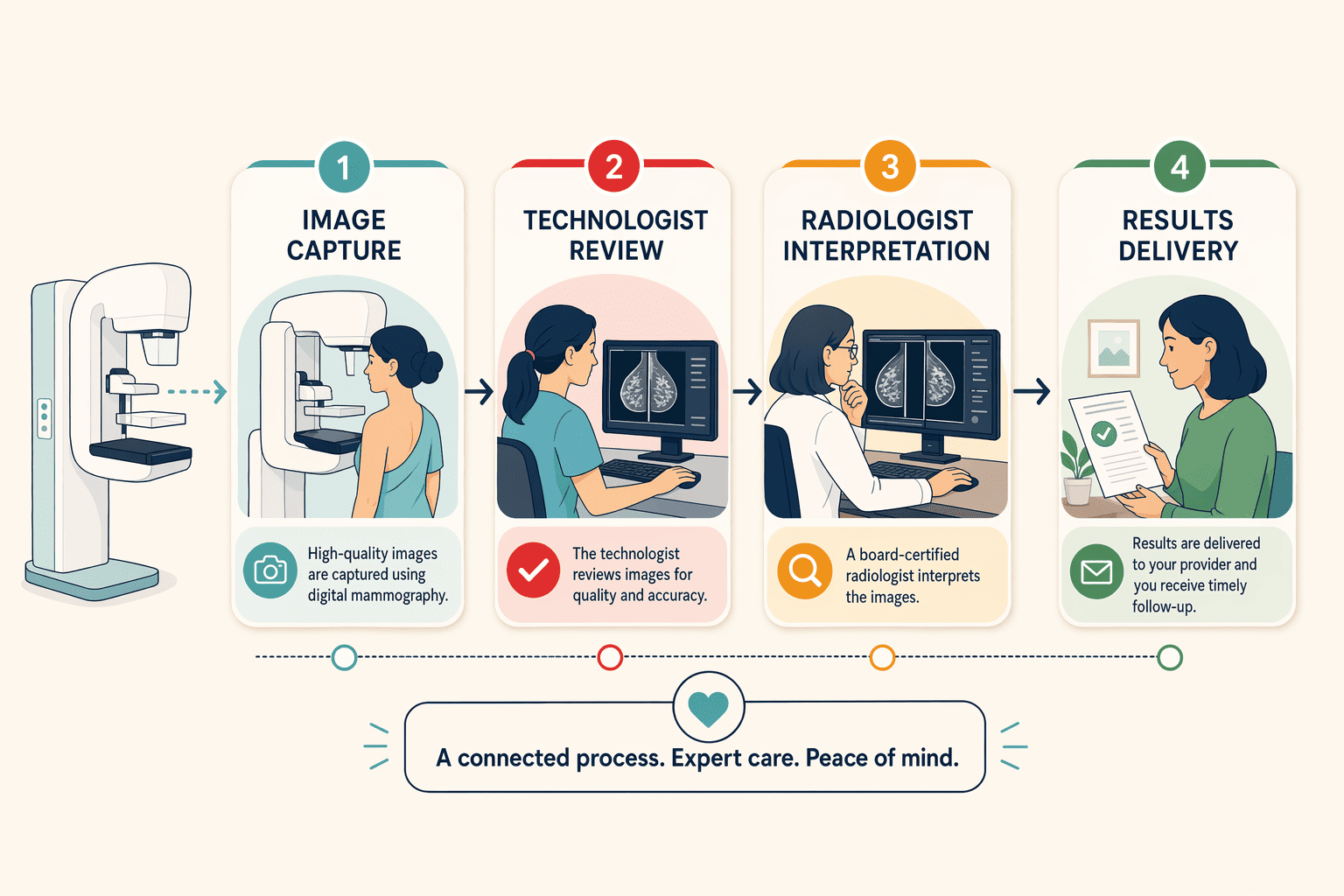
- Image Transmission and Quality Control: Digital mammography images are transmitted to the facility's Picture Archiving and Communication System (PACS) immediately after capture. The radiologic technologist reviews each image for technical adequacy, adequate breast compression, proper positioning, absence of motion artifact, and flags any studies requiring retakes before the patient leaves the imaging suite. This quality-control step prevents downstream delays when the radiologist opens the study and discovers unusable images.
- Radiologist Interpretation and Double-Read Protocols: Single-read workflows allow one radiologist to interpret and finalize the study; double-read workflows, common in government-funded screening programs, require a second radiologist to independently review the images, adding 24 to 48 hours but improving diagnostic accuracy. The double-read model reduces false negatives but doubles the reading workload, constraining throughput when radiologist availability is limited.
- Comparison with Prior Mammograms: Radiologists perform side-by-side comparison with prior studies to detect interval changes, new masses, evolving calcifications, architectural distortion. When prior films are stored at an external facility, the radiology department must request them, wait for physical courier delivery or digital upload, manually upload scanned films to PACS if they arrive on CD, and then perform the comparison, a process that can add 2 to 5 business days when the external facility has its own backlog. This comparison-film retrieval bottleneck is the strategist's identified knowledge gap and explains why facilities with on-site prior-film libraries achieve faster turnaround.
- Report Generation and Physician Notification: The radiologist generates a BI-RADS-structured report, Breast Imaging Reporting and Data System categories 0 through 6, transmits it to the ordering physician, and triggers patient notification. Andromeda Cancer Hospital provides same-day or next-day report turnaround when Steps 1 to 3 are optimized: in-house radiologists eliminate batch-processing delays, PACS integration streamlines image transmission, and an on-site prior-film library removes external-retrieval wait times.
The 2 to 7 day norm is not a technical constraint, it is an institutional workflow choice. A pilot program at the University of Utah demonstrated that patients can receive mammography results within 10 minutes of their scan when the radiologist is on-site during screening and interprets images in real time, bypassing Steps 2 to 3 entirely. Women who previously waited an average of 6 days for results now receive immediate clarity, eliminating the anxiety inherent in delayed notification. Nearly all breast imaging practices in the U.S. Still operate in batch mode because they prioritize radiologist efficiency over patient experience, but the Utah model proves same-day reporting is feasible when workflow design centers on reducing patient harm rather than maximizing radiologist throughput.
If your results are delayed beyond the facility's stated timeline, the next section walks through when and how to proactively follow up with the radiology department to obtain clarity without compromising the quality-control steps described above.
Understanding the behind-the-scenes workflow clarifies when passive waiting becomes active delay, and when you should initiate follow-up.
When Should You Follow up on Delayed Results?
Knowing when to follow up transforms waiting from passive anxiety into active advocacy. Federal regulations require facilities to deliver results within 30 days of the mammography examination, but that outer boundary doesn't define *appropriate* wait times, it marks the legal maximum, not the clinical standard.
Screening Mammogram: Follow up After 5 Business Days
For routine screening exams, results typically arrive within 48 to 72 hours at institutions with integrated radiology workflows. If you haven't received your summary by the end of the fifth business day, initiate follow-up. Contact the radiology department directly first, they can check report status, confirm your contact information is current, and verify the report was transmitted. If the department confirms the report was sent but you never received it, escalate to your ordering physician's office to request a duplicate summary and verify their records match yours.
Diagnostic Mammogram: Follow up After 7 Business Days
Diagnostic mammograms involve comparison with prior imaging, additional views, and sometimes ultrasound correlation, all of which extend interpretation time legitimately. Research shows that 69% of women received follow-up within 7 days for diagnostic mammograms, reflecting the clinical complexity rather than administrative delay. If you haven't heard back by the seventh business day, contact the facility. Ask whether the radiologist has completed the interpretation and whether the report has been transmitted to your physician. If the interpretation is complete but communication failed, request immediate transmission; if the interpretation is still pending, ask for an estimated completion date.
When Delay May Signal a Problem Vs Normal Workflow Backlog
Distinguish administrative failure from workflow volume. Acknowledged delay, "Your radiologist is reviewing; expect results by Friday", is workflow backlog, normal in high-volume practices. Unacknowledged delay, unreturned calls, no status update, "we'll look into it" without follow-through, signals administrative breakdown. Studies document that delayed or failed follow-up after abnormal screening remains a persistent patient-safety issue, often rooted in lost contact information or misfiled reports rather than clinical bottlenecks. Don't assume no news is good news. If two contact attempts within 48 hours yield no substantive response, escalate to your ordering physician or the facility's patient advocate. Administrative errors do happen, and proactive follow-up ensures you don't fall through the cracks.
Proactive follow-up protocols are half the equation; the other half is choosing a facility designed to collapse the workflow variables identified earlier into a single coordinated system.
How Integrated Radiology Departments Reduce Wait Times
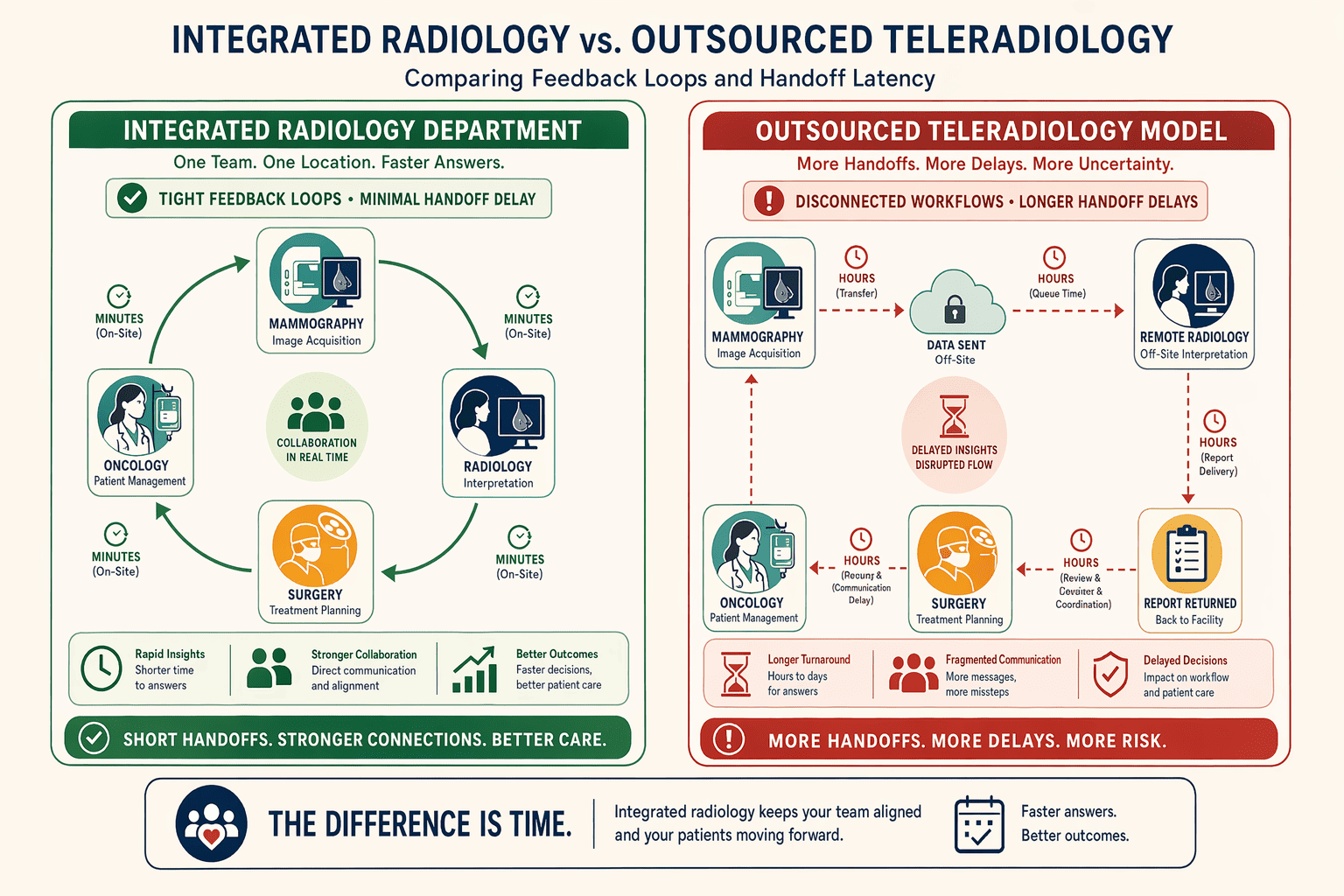
Mammography turnaround depends on institutional design, not just scanner throughput. Centers that integrate radiology with surgical and medical oncology accelerate post-imaging decision-making by eliminating handoff latency between departments.
In-House Radiologists Vs Outsourced Teleradiology
When radiologists work on-site, technologists can request real-time feedback on image quality, reducing repeat-scan rates and enabling same-day report generation. Outsourced teleradiology models introduce transmission latency and eliminate callback coordination, reports often arrive the next business day, but scheduling a follow-up biopsy or surgical consult requires a separate external referral, adding 1-2 weeks to the diagnostic timeline.
Same-Roof Diagnostics and Post-Mammogram Care Coordination
Integrated facilities accelerate post-mammogram action when a biopsy is recommended. Max Institute of Cancer, V Care Cancer Center, and Apollo Cancer Centre each co-locate radiology with surgical and medical oncology, enabling same-day surgical consultations after abnormal mammography results. Apollo Athenaa's breast cancer pathway illustrates the timeline compression: mammography, biopsy coordination, and surgical consult scheduling happen within 48 hours when all services operate under one roof, compared to the 7-10 day referral cycle at standalone imaging centers.
Tumor Board Scheduling and Treatment Planning Speed
Weekly tumor board scheduling reduces wait time between diagnostic imaging and treatment planning. Andromeda Cancer Hospital convenes multidisciplinary tumor boards twice weekly, coordinating PET-CT and IHC testing turnaround within one week for tumor board review. MUSC Hollings follows a similar weekly cadence, with specialists from medical oncology, surgery, radiology, radiation oncology, and pathology reviewing clinical history and imaging to create individualized treatment plans, a workflow structure that centers like BigOHealth replicate in virtual tumor board models for distributed care coordination. The breast oncology pathway and onco-pathology services at integrated facilities connect mammography turnaround directly to treatment planning workflow, compressing the diagnostic-to-decision timeline when the six workflow factors from Section 2 are optimized.
The FAQ section addresses patient-specific questions about report timelines, second opinions, and self-advocacy when navigating institutional workflow differences.
Conclusion
Standalone imaging centers often have lower upfront costs but require external referrals for biopsy or surgical consult, adding 1 to 2 weeks to the post-mammogram care timeline. Integrated cancer hospitals coordinate diagnostics, pathology, and treatment planning under one roof, reducing total time-to-treatment even if the initial mammography fee is higher.
As AI-assisted mammography interpretation and cloud-based PACS integration become standard, the 2 to 7 day turnaround window will compress, but institutional workflow design (in-house radiologists, tumor board coordination, same-roof oncology) will remain the differentiator between fast reporting and fast care.
If you're overdue for a mammogram or have been waiting longer than 7 days for results, schedule a consultation at Andromeda Cancer Hospital to discuss same-day diagnostic imaging and coordinated breast cancer care.
Frequently Asked Questions
How long does it take to get mammography results?
Most screening mammogram results arrive within 48 to 72 hours, while diagnostic mammograms typically take 3 to 7 days due to additional views and prior-film comparison. The FDA requires notification within 30 days, so these timelines fall well within the regulatory standard.
Why are my mammography results taking longer than 7 days?
Delays beyond 7 days usually stem from radiologist backlog, image quality retakes requiring technologist rescans, prior-film retrieval from external archives, diagnostic complexity, outdated PACS systems, or outsourced teleradiology queues. Contact the radiology department after 7 business days for diagnostic mammograms to request a status update.
Does a delay in mammography results mean something is wrong?
No, delays almost always reflect workflow backlog rather than clinical urgency. High-volume practices experience normal turnaround lags, and the FDA's 30-day notification requirement shows that 2 to 7 days remains standard. Acknowledged delays with updated timelines indicate routine administrative processing, not abnormal findings.
What happens if I'm called back after a mammogram?
Callbacks occur in 10 to 15 percent of screening mammograms and typically require additional views or ultrasound correlation, most do not result in biopsy. Diagnostic mammograms involve comparison with prior imaging and extended interpretation time, which explains the 3 to 7 day turnaround for callback assessments.
Can I request same-day mammography results?
Yes, when a radiologist is on-site during screening, facilities like the University of Utah pilot program deliver results within 10 minutes. However, same-day reporting is not standard practice at most centers. Diagnostic mammograms with clinical urgency may qualify for expedited interpretation upon request.
Should I follow up with my doctor or the radiology department about delayed results?
Contact the radiology department for status updates on report generation, and your ordering physician for results discussion once the report is complete. Initiate follow-up after 5 business days for screening exams and 7 business days for diagnostic mammograms if results have not arrived.
How do integrated cancer hospitals reduce mammography turnaround time?
Facilities with in-house radiologists, PACS integration, and same-roof diagnostics achieve same-day or next-day reporting by enabling real-time image quality feedback and coordinated tumor board scheduling. Integrated centers like Andromeda Cancer Hospital convene multidisciplinary tumor boards twice weekly, compressing post-mammogram care timelines.
Sources
- Getting Mammogram and Other Test Results - breastcancer.org (2026)
- How Long Does It Take to Get Mammography Results? - raddoctor.net
- Mammography Information for Patients | FDA - fda.gov
- Breast screening results delayed in SA as mammogram provider seeks more radiologists - ABC News - www.abc.net.au (2024)
- How 1 radiology department cut its mammography turnaround times - radiologybusiness.com (2025)
- Teleradiology in India: Bridging the Mammography Reporting Gap - oshininfotech.com
- Breast Cancer Screening with Immediate Results | Radiology - medicine.utah.edu (2017)
- Frequently Asked Questions About MQSA | FDA - fda.gov
- Delayed or failure to follow-up abnormal breast cancer screening results - PMC - pmc.ncbi.nlm.nih.gov
- Timing of Follow-up After Abnormal Screening and Diagnostic Mammography - www.ajmc.com (2011)
- Best Cancer Hospital in Delhi NCR, India: Book Oncologist - Max Healthcare - www.maxhealthcare.in
- Home - V Care Cancer Center - vcarecancercenter.com
- Apollo Cancer Institute, Best Cancer Hospital in Delhi - Apollo Hospitals - www.apollohospitals.com